Beyond Words: Consciousness, Narrative, and the Three Worlds
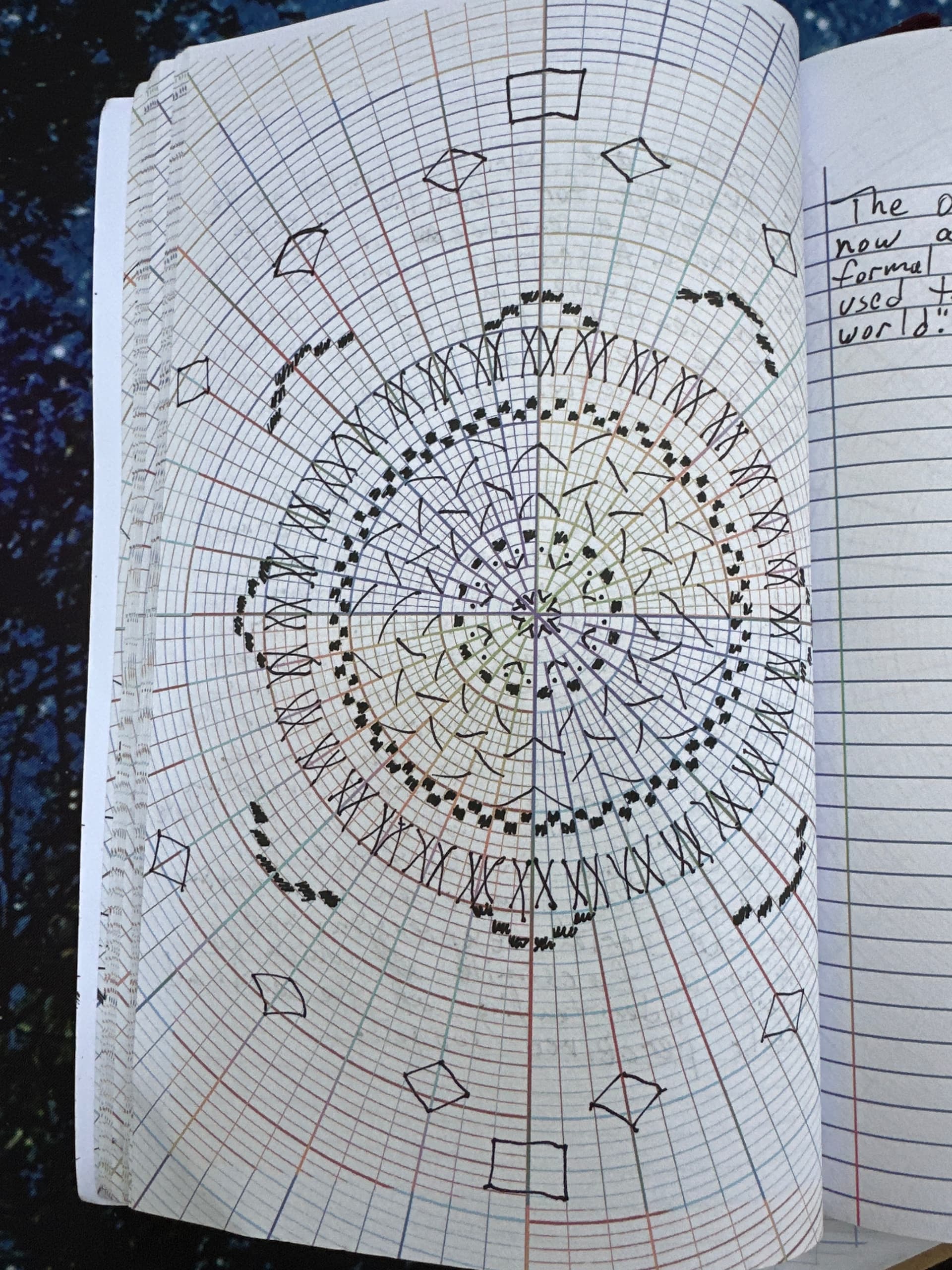
In the midst of words and worlds, we often forget that the maps we draw and the stories we tell are not the territory itself. Every sentence we write, every theory we build, is a sequence of symbols—charts, diagrams, equations, or prose—arranged to evoke something beyond themselves. Yet those symbols remain inert until they alight in a mind that carries memory, expectation, and sensation. In this post, I’m investigating the three interrelated yet necessarily distinct worlds of experience—the Subjective, the Objective, and the Corporeal Worlds—unified by the recognition that consciousness is the container in which all experience arises, and that narrative, while indispensable, always falls short of capturing the fullness of living reality.
I. Consciousness as Container
At the heart of our investigation lies a simple but profound insight: every experience we ever know—every sight, sound, thought, or feeling—occurs within the field of consciousness. Think of consciousness not as a thing, but as an open vessel: a continuous, flowing space in which phenomena appear, linger, and dissolve. This “container” is not empty; it is charged with memory traces, anticipations, moods, and conceptions. It holds:
- Immediate Sensations: the raw buzz of a mosquito’s wings, the sting of a bee, the warmth of sunlight on skin.
- Mental Images: recollections of past events, imagined futures, dreams half-formed in the edges of awareness.
- Conceptual Frames: languages, theories, cultural norms, and symbolic systems that shape how raw data are interpreted.
- Emotional Tones: moods that color perception—a sense of buoyancy or foreboding that tints every experience.
This container is finite and situated. It has a horizon: beyond the edges of awareness lie unnoticed stimuli, untold memories, and unborn possibilities. Consciousness is not a mirror passively reflecting an external world; it is a crucible in which perception, memory, thought, and feeling coalesce. Recognizing this is the first step toward understanding how we navigate the Three Worlds.
II. Narrative’s Power and Limits
Narrative is our principal tool for sharing what transpires within the container of consciousness. We string words into sentences, sentences into paragraphs, and paragraphs into essays—in effect, constructing a linear map that points back to the non-linear territory of lived experience. Narrative bears tremendous power:
-
Coherence and Memory
Stories impose order on chaos. By presenting events in sequence—beginning, middle, end—we anchor fleeting moments in a structure that memory can retain and recall. -
Shared Understanding
Through common vocabulary and idioms we negotiate meaning across minds. A well-told narrative can dissolve barriers of culture, education, or geography, allowing others to inhabit our perspectives. -
Emotional Resonance
Narratives carry affect. A description of loss, surprise, or triumph can evoke in readers’ hearts the tang of sorrow or the thrill of victory, even if they have never lived the exact events.
Yet narrative is also limited:
-
Linearity vs. Lived Flux
Consciousness is not inherently serial. Our thoughts flicker, overlap, and interpolate. Narrative’s neat progression can flatten the interleaving of simultaneous sensations or associations. -
Reduction of Detail
Every word is a concession. To write “a crackling fire” is to omit the stinging heat in your eyes, the acrid scent of burning resin, the imperceptible shift of hot air under your palm. The narrative must select, shape, and prune. -
Dependence on Shared Context
Words resonate only when a reader has relevant memory banks. A metaphor drawn from tectonic plates may puzzle someone without geoscience exposure. Narrative is never fully transparent. -
Illusion of Completeness
The map can seduce us into believing it is the territory. We might cling to our stories as if they were incontrovertible truths rather than provisional sketches.
In short, narrative is a skillful means—a “upāya” in Buddhist terms—but not an ultimate ground. It serves our practical needs, yet its very utility can blind us to what lies beyond its borders.
III. The Three Worlds Defined
To navigate this terrain of map and territory, we distinguish three interdependent domains—a triad whose interplay gives rise to all experience:
-
The Subjective World (Conscious Container)
The domain of first-person presence: thoughts, feelings, intentions, memory, and imagination. It is the seamless field of awareness in which phenomena present themselves. It includes the narrator’s voice, the pulse of emotion, and the silent substrate of pre-reflexive being. -
The Objective World (Symbolic Map)
The realm of formal and informal symbols: words, mathematics, diagrams, legal codes, scientific models, software code. This is the shared intersubjective order we build to communicate, predict, and coordinate. It is the map—with all its abstractions, axioms, and proofs—but never the territory itself. -
The Corporeal World (Lived Territory)
The lived body and its direct engagement: sense data, embodied action, tactile resistance, pain, pleasure, and physiological processes. This is the territory that “pushes back”—the element that eludes complete modeling. It is where matter shows its irreducible presence: the heat of coals, the weight of a log, the oscillating tenor of breath.
Each world has its own mode of truth:
- Subjective: existential veracity—what it is like.
- Objective: coherence and intersubjective validation—consistency within symbolic systems.
- Corporeal: presence and contact—phenomenological immediacy.
And each is empty of independent essence. The Subjective World lacks a permanent self, the Objective World lacks inherent referents apart from symbols, and the Corporeal World lacks an unchanging substance. Their emptiness is the condition of their interdependence.
IV. Experience as Dynamic Reconciliation
To experience is not to reside solely in one world, but to navigate the currents among all three:
-
Perceiving a Scene
Your eyes register the light flickering through branches (Corporeal). Your brain applies categories—“redwood,” “pine needle,” “evening light”—invoking scientific and cultural models (Objective). Simultaneously, a sense of awe or tranquility arises (Subjective). The three realms co-emerge. -
Crafting a Model
Suppose you wish to predict how a fire will spread in a grove. You consult thermodynamic equations (Objective), recollect memories of past campfires (Subjective), and step closer to feel heat patterns on your skin (Corporeal). Each realm informs and corrects the others. -
Sharing an Insight
You then compose a post: “When embers lift with the evening breeze, the forest floor warms unevenly, reminding us that prevailing wind models must account for local topography.” In writing this, you translate an embodied observation (Corporeal) filtered through scientific theory (Objective) into a narrative accessible to others (Subjective → Objective). Readers, in turn, re-evoke the scene within their own consciousness.
This ongoing loop is dependent co-origination in action. No world stands alone; each requires the others to function. Consciousness bridges map and territory, narrative encodes experience, and the body grounds abstract models in lived fact.
V. The Limits of Narrative: A Case Study
Imagine you sit beside a campfire at dusk. A sudden gust sends embers arching toward dry needles. In that split second, you:
- Feel a prick of alarm in your chest (Subjective).
- Hear the snap of wood as it rolls in the pit (Corporeal).
- Recall the fire-safety guidelines you read this morning (Objective).
- Decide to rearrange the logs to create a windbreak (Subjective acts).
- Explain later in writing: “I noticed ember showers and repositioned logs to shield the base from wind-driven sparks.”
Your post captures the sequence but inevitably omits:
- The subtler tremor in your fingertips as you fumbled the poker.
- The sulfurous tang behind your nostrils.
- The slight hesitation before action, carried by memory of past burns.
- The exact trajectory, which no diagram can fully render.
The narrative version becomes a compressed map of a richer territory. It serves others well enough to replicate the safety step—but it cannot transmit the visceral urgency you felt. A reader may nod in understanding yet remain untouched by the flicker of light that once danced on your sleeve.
VI. Embracing Provisional Maps
Given these limitations, how should we work with narrative and symbolic systems?
-
Acknowledge Partiality
Every model—be it an engineering diagram or a 2,000-word essay—is a selective rendering. We must resist the temptation to elevate our maps into ultimate reality. -
Practice Triadic Awareness
In any act of inquiry or communication, pause to ask:- What is my mind (Subjective) adding to these symbols?
- How does the symbolic order (Objective) constrain or illuminate my thought?
- What does my body (Corporeal) tell me that neither theory nor narrative can fully capture?
-
Cultivate Embodied Checks
When possible, validate your theories through direct engagement: measure temperature, listen to wind, feel the weight of objects. Let the territory correct the map. -
Use Multimodal Expression
Combine sketches, audio, video, and even simple gestures with narrative to approximate the texture of lived experience. Each medium emphasizes different facets of the three worlds. -
Hold Emptiness as Insight
Recognize that the lack of inherent essence in maps and experiences is not a curse but the condition of creativity. It frees us from dogmatism and invites ongoing exploration.
VII. Practical Applications
In Science and Engineering
Scientists build models of combustion or climate that serve as maps for prediction. Yet field work—data gathered by sensors, felt insight from instrumentation—grounds these models in empirical reality. A predictive model that fails to account for local wind currents is no better than a fictional narrative.
In Therapy and Well-Being
Mindfulness practices train us to observe bodily sensations (Corporeal) and mental processes (Subjective) without clinging to narratives about the self. Cognitive therapies help rewrite maladaptive stories (Objective) while honoring the felt quality of emotion.
In Education and Collaboration
Teaching thrives when students engage through reading (Objective), reflection (Subjective), and hands-on projects (Corporeal). A physics lesson that includes experiments fosters deeper understanding than equations alone.
In Ethics and Politics
Policies are maps of social action: laws, budgets, regulations. Without attention to lived context—stories of individuals affected, physical conditions of communities—these maps risk causing harm when implemented.
VIII. Conclusion: Navigating the Map and the Territory
Our lives unfold in the intersection of three worlds: the Subjective reservoir of awareness, the Objective network of symbols, and the Corporeal domain of flesh and matter. Consciousness is the container in which these realms meet, clash, and harmonize. Narrative and formal systems are our indispensable means of charting that meeting ground, yet they are, at best, provisional sketches.
To live wisely is to hold a both/and stance:
- Both value narrative for its power to share, instruct, and inspire
- And remain humble about its limits, ever attentive to the territory it points toward
In doing so, we honor the emptiness at the heart of things—not as a nihilistic void, but as the space of possibility. Form and emptiness dance together, revealing a reality richer than any single map. Let us continue to draw our lines, write our sentences, and build our models—all the while keeping one eye on the story and the other on the world it seeks to reveal.