Experience as Reconciliation: A Phenomenological Framework of the Three Worlds
Introduction: Clarifying Map and Territory
When we speak of “reality,” we often lapse into a binary: “subjective” versus “objective.” Yet this dichotomy conceals a more nuanced architecture of experience. If we mistake maps (our symbolic representations) for territory (the lived, flesh-and-blood ground of existence), we build our theories on soft foundations.
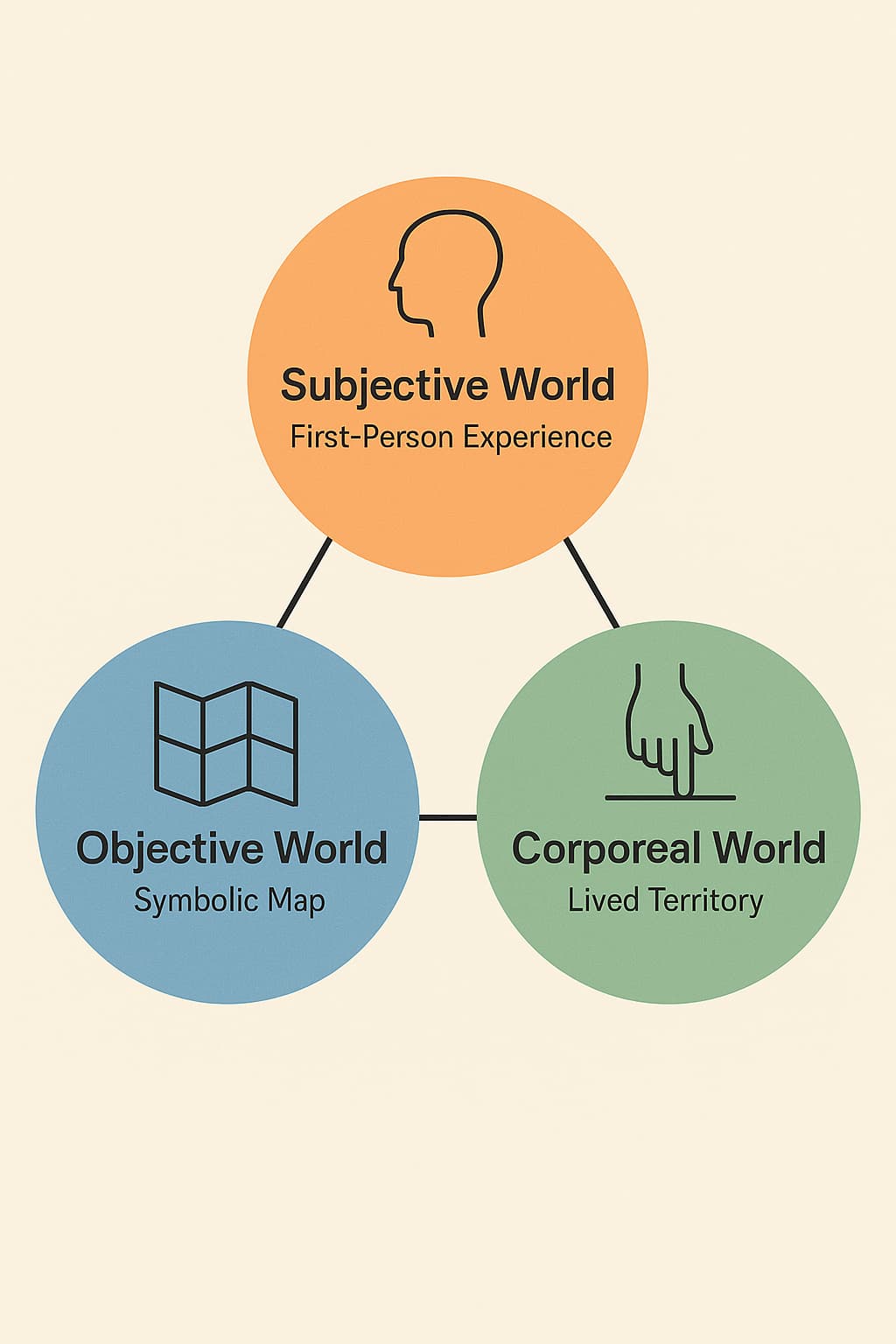
This article offers a thoroughly revised “Three Worlds” model—grounded in Heart Sutra Science, phenomenology, and contemporary cognitive science—that insists on a crucial correction:
- The Subjective World: the interior domain of first-person awareness—thoughts, feelings, intentions.
- The Objective World: the symbolic domain of maps—languages, theories, diagrams, formal systems.
- The Corporeal World: the territory of embodiment—sensory immediacy, matter as it is touched, felt, and measured.
Only the Corporeal World can truly be touched or measured; the Objective World is, by definition, a map—an abstract encoding of patterns that point back to the territory. Meanwhile, the Subjective World is the living flow of consciousness that inhabits, interprets, and sometimes misreads both map and territory.
This framework rejects naïve realism (that our maps somehow coincide with a mind-independent “world”) and reductive idealism (that all that exists is consciousness). Instead, each “world” is a distinct pole of experience, interwoven in a dynamic reconciliation that is what we call “experience.”
I. Background: Heart Sutra Science and Phenomenological Antecedents
1.1 The Heart Sutra and Emptiness
The Heart Sutra declares: “Form is emptiness; emptiness is form.” This core Mahāyāna insight tells us that no phenomenon—mental or physical—possesses intrinsic essence. Everything arises dependently (pratītyasamutpāda). Heart Sutra Science extends this by treating consciousness not as a mirror of reality, but as a mediating activity reconciling symbolic models (Objective), lived embodiment (Corporeal), and affective intentionality (Subjective).
1.2 Phenomenological Foundations
- Husserl: Consciousness is always “about” something (intentionality). He introduced the epoché—bracketing assumptions to observe experience as it appears.
- Merleau-Ponty: Our bodies are not mere objects but the means by which we perceive and act. The lived body (Leib) is pre-reflectively embedded in the world.
- Derrida: All meaning is deferred through signs (différance). Maps—language, models, systems—are never the territory.
1.3 Nāgārjuna and Emptiness
Nāgārjuna’s Mūlamadhyamakakārikā dissolves fixed essences using the tetralemma: not this, not that, not both, not neither. Every “thing”—including selves, thoughts, bodies—is empty of inherent nature yet still functions.
1.4 Predictive Processing and Embodied Mind
Modern cognitive science (especially predictive processing) supports this view. The brain is not a passive observer but a prediction engine: it models reality based on sensory data (Corporeal) and updates its internal frameworks (Objective) under the influence of affective context (Subjective). This ongoing reconciliation of map and territory is experience.
II. The Subjective World: First-Person Presence
2.1 What It Is
The Subjective World consists of:
- Feelings, moods, qualia
- Inner speech and narrative
- Imagination, anticipation, memory
- Values, fears, identity
It is the interior stream of meaning-making, the “what it is like” to be.
2.2 How We Know It
- Introspection and mindfulness
- Phenomenological description
- First-person reporting
Subjective states are not always articulate, but they are experientially undeniable.
2.3 Its Truth
The Subjective World is existentially true: it is how life is lived. But it is also empty of permanence—no stable self exists beneath its flowing contents.
III. The Objective World: The Symbolic Map
3.1 What It Is
The Objective World is composed of:
- Language, mathematics, logic
- Scientific models and diagrams
- Legal codes and institutional systems
- Algorithms, maps, formulas
These are representational structures. They model—but do not instantiate—reality.
Matter is not here. The Objective World is the map, not the territory.
3.2 How We Know It
- Formal reasoning
- Shared linguistic and symbolic systems
- Intersubjective verification
Objectivity is built through coherence, not contact.
3.3 Its Truth
The Objective World is true through symbolic coherence and shared reference. Yet it is also empty: all systems are contingent abstractions.
IV. The Corporeal World: The Lived Territory
4.1 What It Is
The Corporeal World is the felt, physical world of:
- Bodies in motion
- Touch, pain, pressure
- Breathing, hunger, aging
- Terrain, resistance, decay
It is the only world that pushes back.
4.2 How We Know It
- Embodied action
- Sensory contact
- Physical vulnerability
We don’t “think” the Corporeal World—we endure it.
4.3 Its Truth
The Corporeal World is present, irreducible, and finite. But it, too, is empty—a temporary pattern of impermanent processes.
V. Experience as Reconciliation
These worlds are not silos—they are co-arising domains. Every experience involves:
- A feeling (Subjective)
- An interpretation or model (Objective)
- A bodily sensation or action (Corporeal)
For example:
- Reading this sentence involves symbolic decoding (Objective), felt comprehension or resistance (Subjective), and bodily engagement—eyes scanning, neurons firing (Corporeal).
| World | Mode | Access | Truth |
|---|---|---|---|
| Subjective | Intentionality, qualia | Introspection, reflection | Existential (felt meaning) |
| Objective | Symbolic, formal | Analysis, verification | Coherence, intersubjectivity |
| Corporeal | Sensory, embodied | Contact, sensation | Presence, immediacy |
VI. Emptiness and the Two Truths
In Buddhist philosophy:
- Conventional truth: Each world “functions” in its domain.
- Ultimate truth: No world has essence. They are empty, arising through interdependence.
Seeing this emptiness is liberating. It allows flexible, compassionate participation in life, without clinging to identity, ideology, or the body.
VII. Implications
7.1 Beyond Dualism
This model rejects:
- Mind-body dualism: Body is not passive matter, but where Subjective and Objective interweave.
- Realism vs. idealism: The world is not just mind or just stuff—it is experienced through all three.
- Reductionism: No realm is reducible to another.
7.2 Ethics of Interbeing
- Ethics grounded in corporeal vulnerability
- Justice shaped by objective structure
- Compassion arising from subjective resonance
To act wisely, we must attend to all three realms.
7.3 The Risk of Map-Fetishism
Our culture increasingly mistakes the symbolic for the real:
- Dataism replaces feeling.
- Virtual reality replaces terrain.
- Ideology replaces empathy.
This model reminds us to return to the body and to the moment.
VIII. Applications
- Contemplative practice: Mindfulness observes all three realms—bodily sensation, mental formation, and conceptual labels.
- Therapy: Trauma is bodily (Corporeal), cognitive (Objective), and emotional (Subjective). Healing must include all.
- Education: True learning integrates embodiment, reasoning, and self-reflection.
- Policy and design: Systems should reflect lived experience, not just abstract efficiency.
IX. Summary
The Three Worlds are:
- Subjective: The lived, personal stream of awareness.
- Objective: The symbolic order of shared models and representations.
- Corporeal: The immediate, tactile, finite ground of the body and the world.
Each is true in its own way. Each is also empty—lacking self-sufficient essence.
To experience is to reconcile these realms—to feel, to interpret, and to be touched by the real.
Further Reading
- Nāgārjuna, Mūlamadhyamakakārikā
- Red Pine (trans.), The Heart Sutra
- Edmund Husserl, Ideas I & II
- Maurice Merleau-Ponty, Phenomenology of Perception
- Jacques Derrida, “Structure, Sign, and Play”
- Thomas Nagel, “What Is It Like to Be a Bat?”
- Andy Clark & Jakob Hohwy, papers on predictive processing
- Shaun Gallagher & Dan Zahavi, The Phenomenological Mind
- Mark Epstein, Thoughts Without a Thinker
- David Kalupahana, Principles of Buddhist Psychology
Posted to the Philosophy Category on social.humanizer.com
June 4, 2025 — by Tem Noon (on behalf of Heart Sutra Science)