6 June 2025
123 days since Edd
23703 Days Old
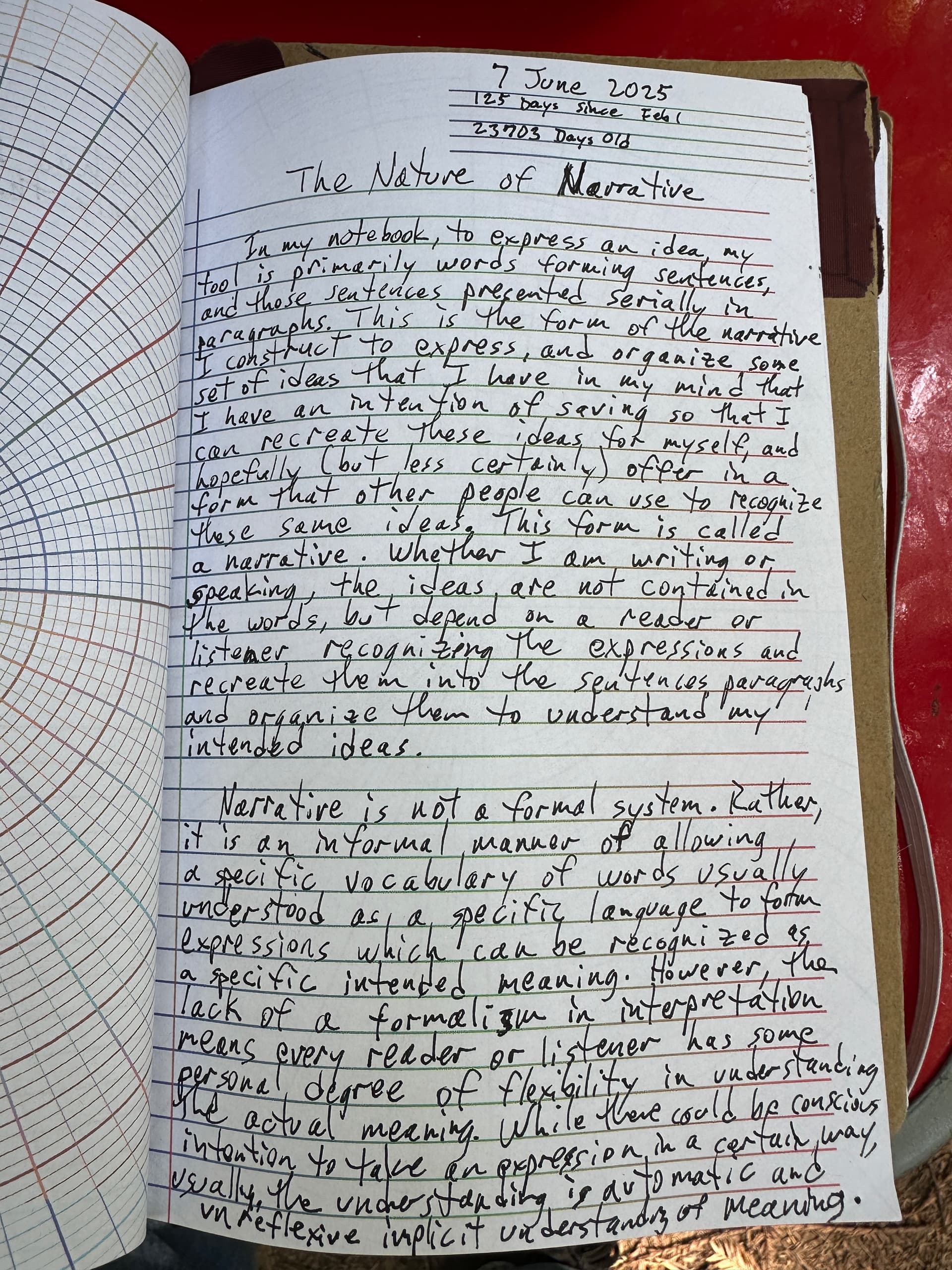
The Nature of Narrative
In my notebook, to express an idea, my tool is primarily words forming sentences, and those sentences presented serially in paragraphs. This is the form of the narrative construct to express and organize some set of ideas that I have in my mind that I have an intention of saving so that I can recreate these ideas for myself and (hopefully but less certainly) offer in a form that other people can use to recognize these same ideas. This form is called a narrative. Whether I am writing or speaking, the ideas are not contained in the words, but depend on a reader or listener recognizing the expressions and recreating them into the sentences, paragraphs and organize them to understand my intended ideas.
Narrative is not a formal system. Rather, it is an informal manner of allowing a specific vocabulary of words (usually understood as a specific language) to form expressions which can be recognized as a specific intended meaning. However, the lack of a formalism in interpretation means every reader or listener has some personal degree of flexibility in understanding the actual meaning. While there could be conscious intention to take an expression in a certain way, usually the understanding is automatic and unreflective, implicit understanding of meaning.
[Page Break]
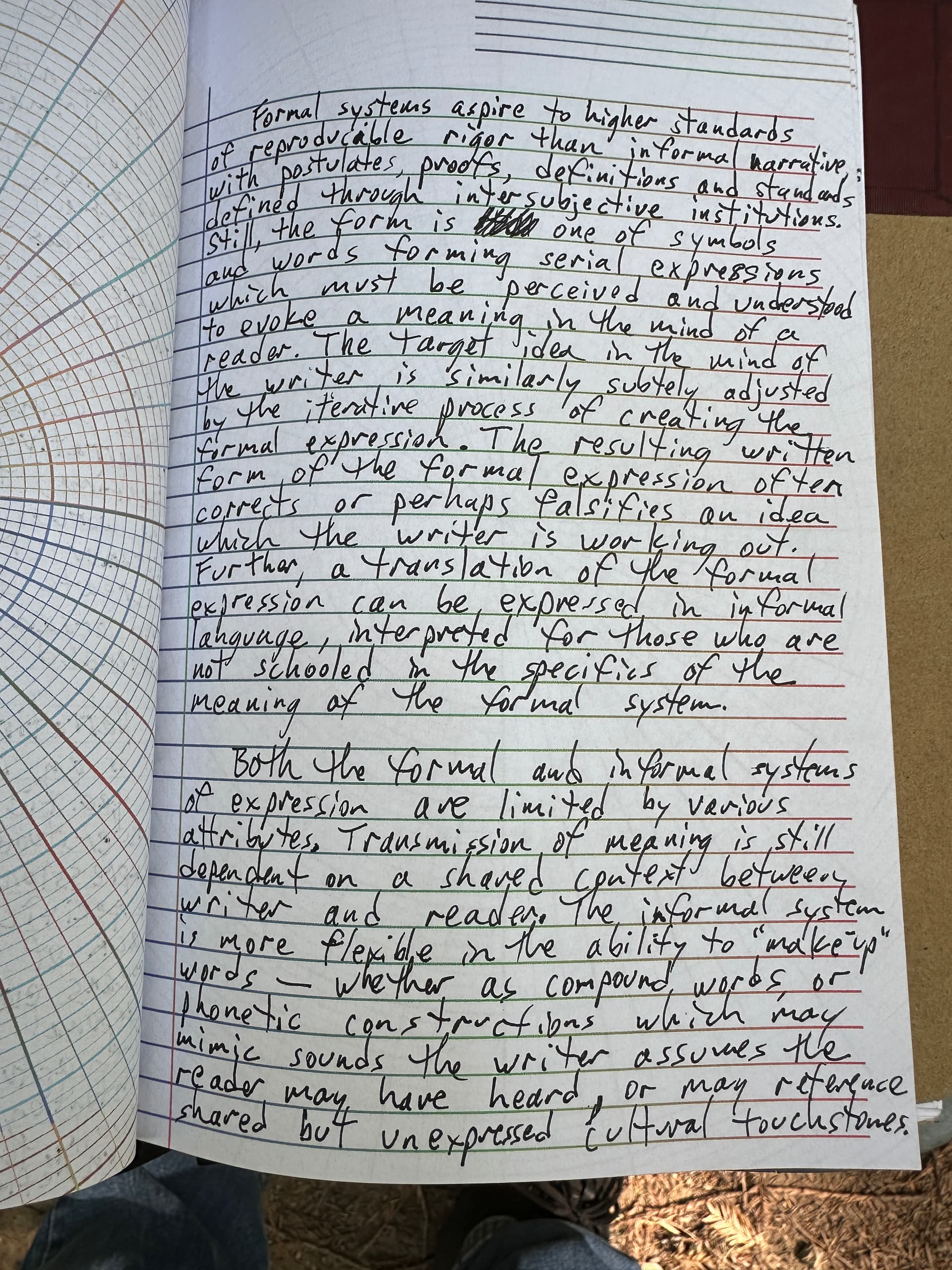
Formal systems aspire to higher standards of reproducible rigor than informal narrative — with postulates, proofs, definitions and standards defined through intersubjective institutions. Still the form is still one of symbols — only words forming serial expressions which must be perceived and understood to evoke a meaning in the mind of a reader. The target idea in the mind of the writer is similarly subtly adjusted by the iterative process of creating the formal expression. The resulting written form of the formal expression often corrects or perhaps falsifies an idea which the writer is working out. Further, a translation of the formal expression can be expressed in informal language, interpreted by those who are not schooled in the specifics of the meaning of the formal system.
Both the formal and informal systems of expression are limited by various attributes. Transmission of meaning is still dependent on a shared context between writer and reader. The informal system is more flexible in the ability to “make up” words — whether as compound words or phonetic constructions which may mimic sounds the writer assumes the reader may have heard or may reference shared but unexpressed cultural touchstones.
[Page Break]
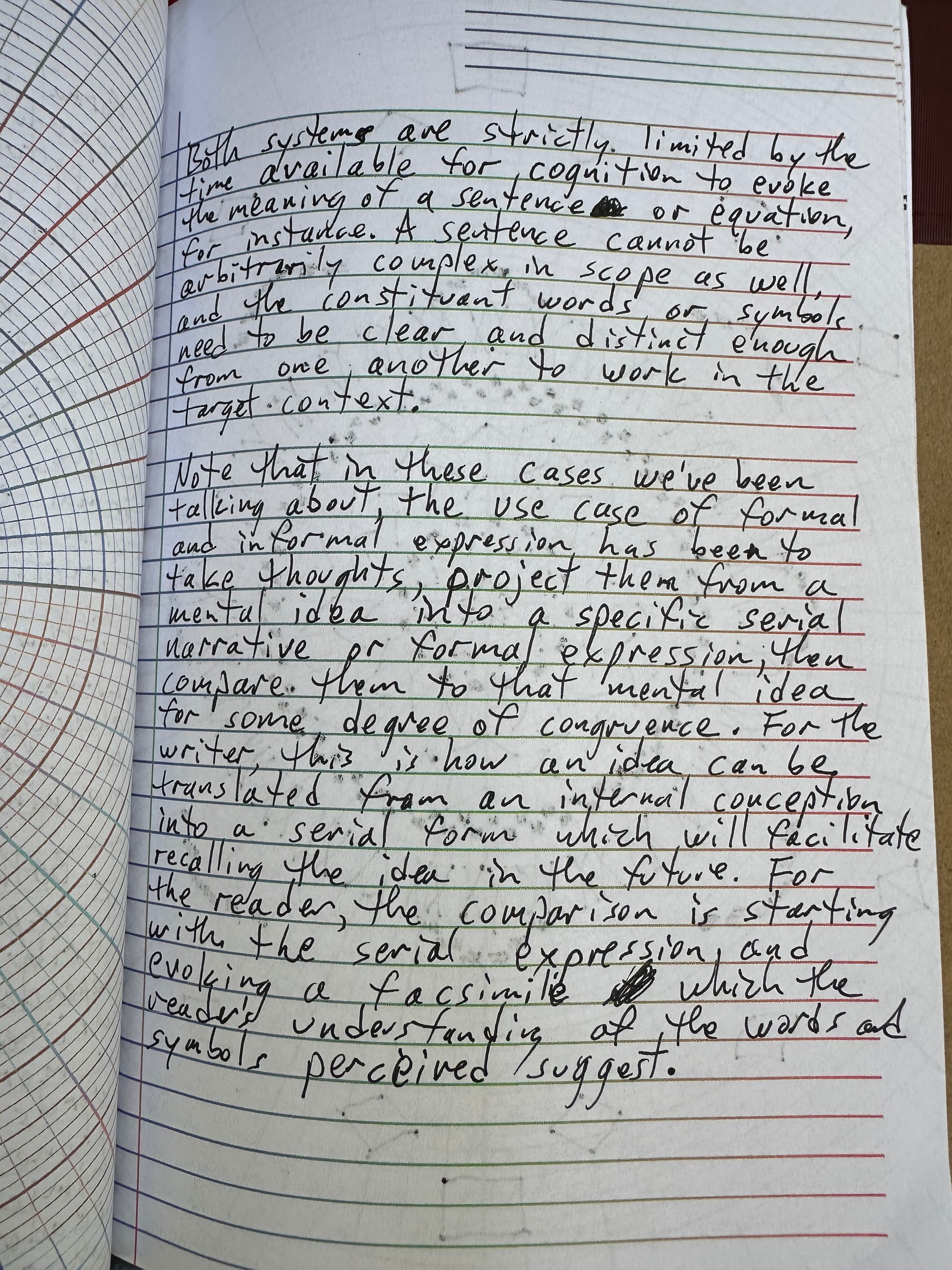
Both systems are strictly limited by the time available for cognition to evoke the meaning of a sentence or equation, for instance. A sentence cannot be arbitrarily complex, in scope as well, and the constituent words or symbols need to be clear and distinct enough from one another to work in the target context.
Note that in these cases we’ve been talking about the use case of formal and informal expression has been to take thoughts, project them from a mental idea into a specific serial narrative or formal expression, then compare them to that mental idea for some degree of congruence. For the writer, this is how an idea can be translated from an internal conception into a serial form which will facilitate recalling the idea in the future. For the reader, the comparison is starting with the serial expression and evoking a facsimile of the idea which the reader’s understanding of the words and symbols perceived suggest.
[Page Break]
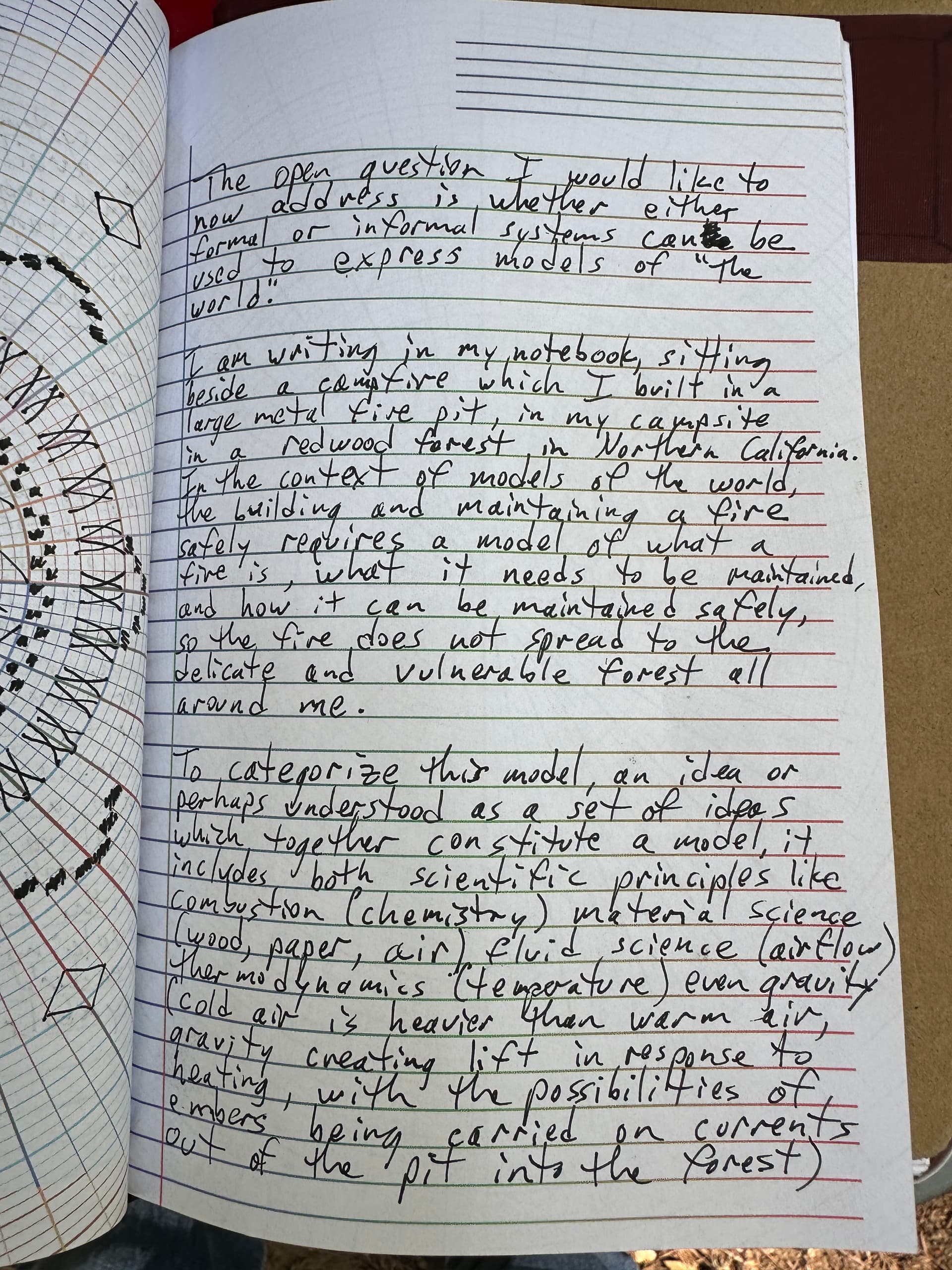
The open question I would like to now address is whether either formal or informal systems can be used to express models of “the world.”
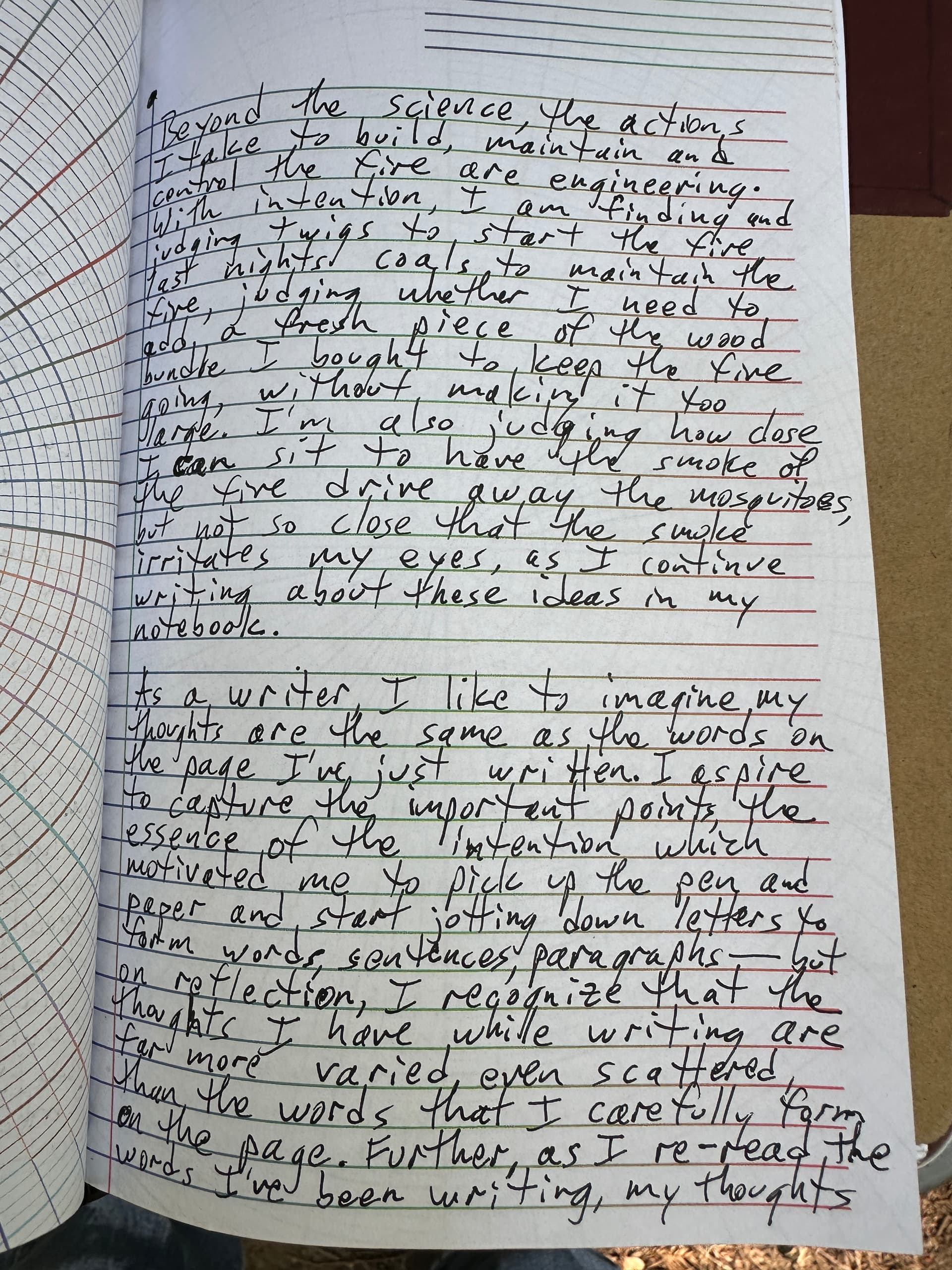
I am writing in my notebook, sitting beside a campfire which I built in a large metal fire pit, in my campsite in a redwood forest in Northern California. In the context of models of the world, the building and maintaining of a fire safely requires a model of what a fire is, what it needs to be maintained, and how it can be maintained safely so the fire does not spread to the delicate and vulnerable forest all around me.
To categorize this model, an idea or perhaps understood as a set of ideas which together constitute a model, it includes both scientific principles like combustion chemistry, material science (wood, paper, air), fluid science (airflow), thermodynamics (temperature), even gravity (cold air is heavier than warm air, creating lift in response to heating, with the possibilities of embers being carried on currents out of the pit into the forest).
[Page Break]
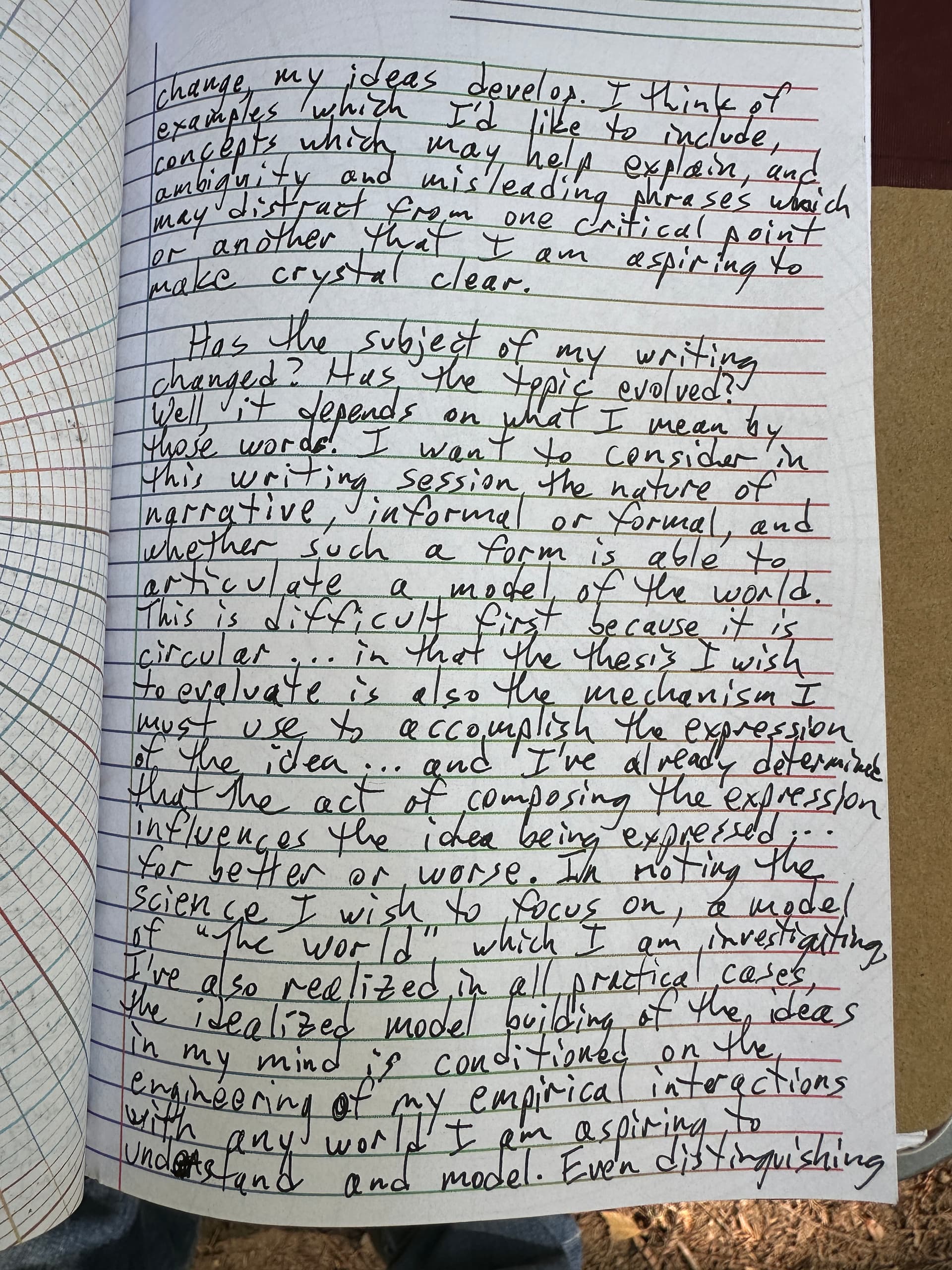
Change, my ideas develop. I think of examples which I’d like to include, concepts which may help explain, and ambiguity and misleading phrases which may distract from one critical point or another that I am aspiring to make crystal clear.
Has the subject of my writing changed? Has the topic evolved? Well, it depends on what I mean by those words. I want to consider in this writing session the nature of narrative, informal or formal, and whether such a form is able to articulate a model of the world. This is difficult, first because it is circular, in that the thesis I wish to evaluate is also the mechanism I must use to accomplish the expression of the idea… and I’ve already determined that the act of composing the expression influences the idea being expressed, for better or worse. In noting the science, I wish to focus on a model of “the world” which I am investigating. I’ve also realized in all practical cases, the idealized model building of the ideas in my mind is conditioned on the engineering of my empirical interactions with any world I am aspiring to understand and model. Even distinguishing
[Page Break]
Beyond the science, the actions I take to build, maintain and control the fire are engineering. With intention I am finding and judging twigs to start the fire, the night’s coals to maintain the fire, judging whether I need to add a fresh piece of the wood bundle I brought to keep the fire going without making it too large. I’m also judging how close to the fire I sit to have the smoke of the fire drive away the mosquitoes, but not so close that the smoke irritates my eyes, as I continue writing about these ideas in my notebook.
As a writer I like to imagine my thoughts are the same as the words on the page I’ve just written. I aspire to capture the important points, the essence of the intention which motivated me to pick up the pen and paper and start jotting down letters to form words, sentences, paragraphs. But on reflection, I recognize that the thoughts I have while writing are far more varied, even scattered, than the words that I can really form on the page. Further, as I re-read the words I’ve been writing, my thoughts
[Page Break]
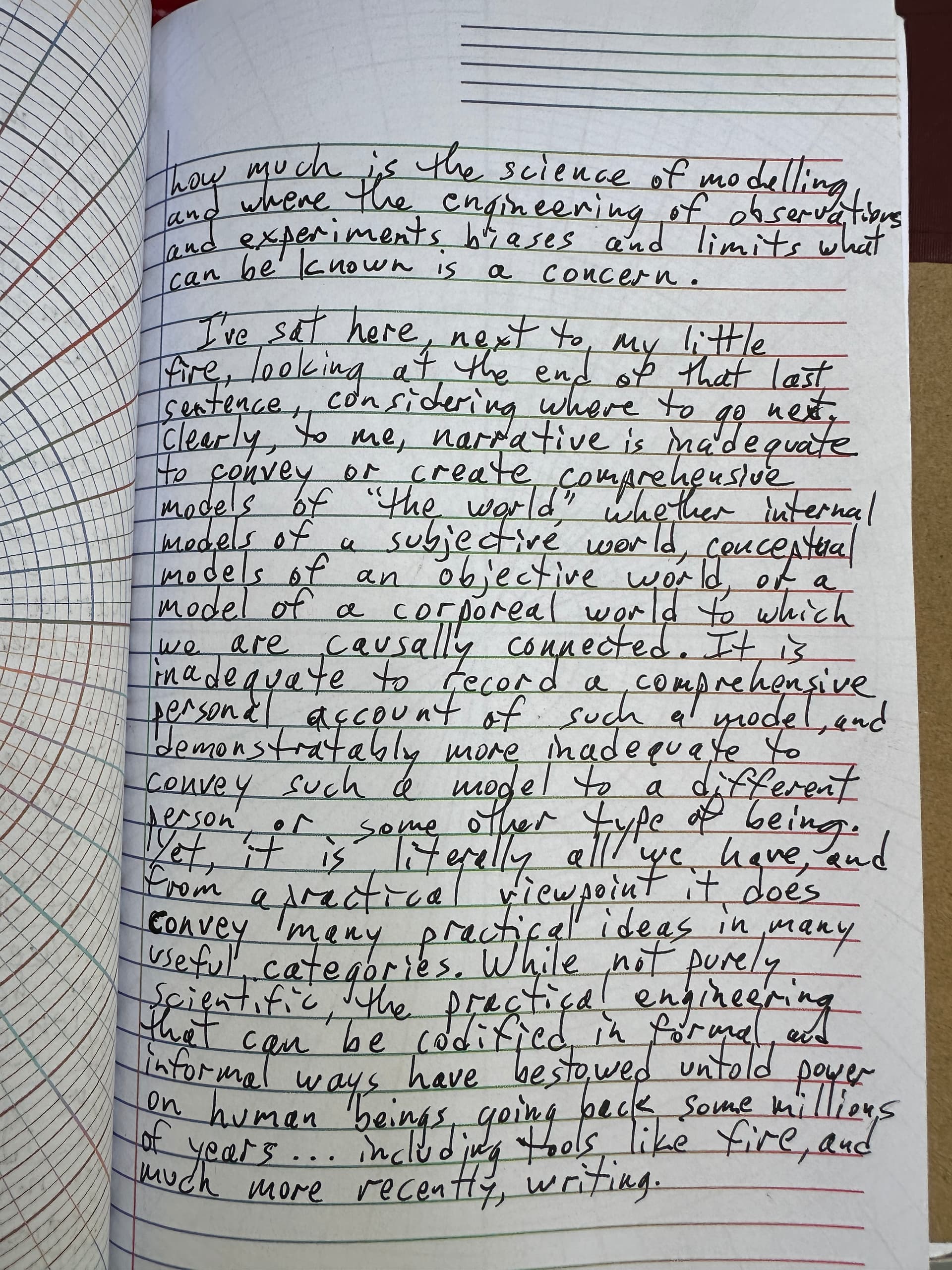
How much is the science of modelling, and where the engineering of observations and experiments, phrases and limits what can be known is a concern.
I’ve sat here next to my little fire, looking at the end of that last sentence, considering where to go next. Clearly to me, narrative is inadequate to convey or create comprehensive models of “the world,” whether internal models of a subjective world, conceptual models of an objective world, or a model of a corporeal world to which we are causally connected. It is inadequate to record a comprehensive personal account of such a model, and demonstrably more inadequate to convey such a model to a different person, or some other type of being.
Yet, it is literally all we have and from a practical viewpoint it does convey many practical ideas in many useful categories. While not purely scientific, the practical engineering that can be codified in formal or informal ways have bestowed untold power on human beings, going back some millions of years… including tools like fire, and much more recently, writing.
[Page Break]
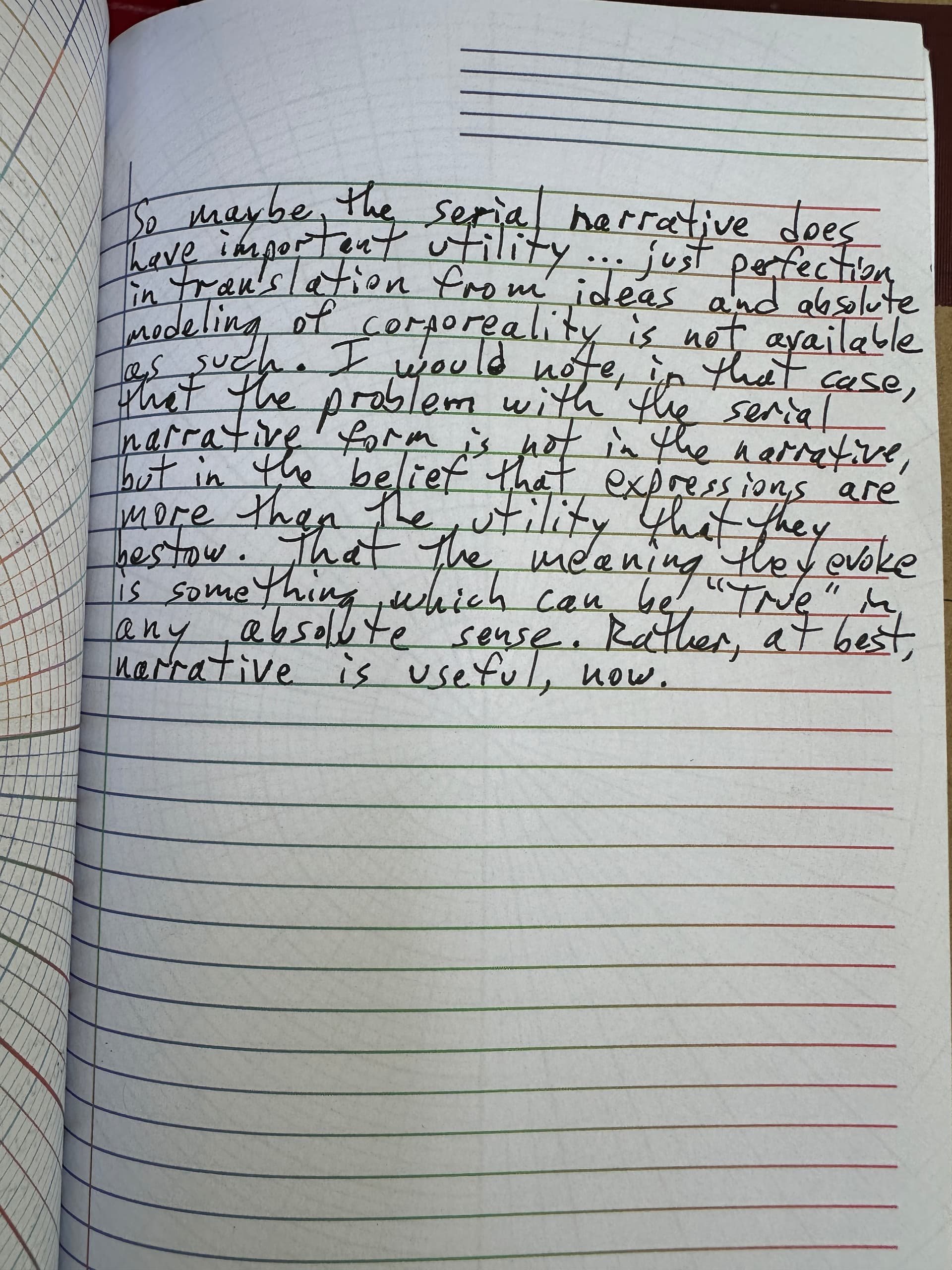
So maybe the serial narrative does have important utility… just perfection in translation from ideas and absolute modeling of corporeality is not available as such. I would note, in that case, that the problem with the serial narrative form is not in the narrative, but in the belief that expressions are more than the utility that they bestow, that the meaning they evoke is something which can be “true” in any absolute sense. Rather, at best, narrative is useful, now.